
|
A "Black Box" Challenge |
Rooting Out the Facts
Various methods for iterative calculation of square root are prodigiously documented, yet I am confident that you have not seen this one previously.
You may recognize this old Babylonian formula, which approximates sqrt(n) from estimate e:
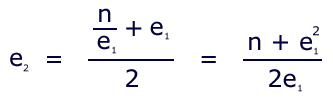
The closer the original estimate, the more nearly correct will be the quotient. Successive iterations of the continued fraction yield increasingly accurate approximations of the root.
Here is my "black box" algorithm for augmenting this
time-honored method:
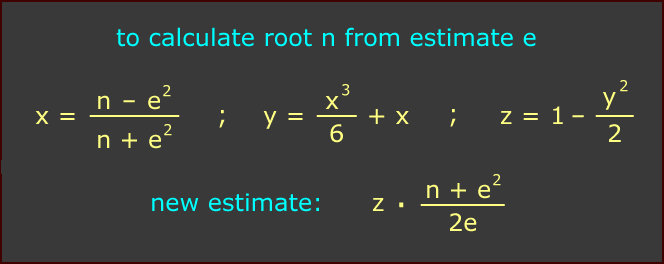
The "z-factor" greatly increases the decimal accuracy of the estimate. My challenge to you is:
How and why does this work?
What actually is
happening here?
Kudos and my undying admiration go to anyone who can unravel the mystery. For everyone else, details are provided. A real human would happily respond to email on this topic.

I have created a little game program to demonstrate the power of the Black
Box. The player is asked to guess the square root of a random integer.
The program displays the actual root, then compares it with a single-iteration
estimate from the Black Box on Level-1, or with the Babylonian approximation
on Level-2. The relative accuracy of a result is dependent upon the
player's guess. It's a game for math nuts only.
Download:
Roots.zip
Trust me! no viruses
Unzip the download and place Roots.exe anywhere on your hard disk; create a shortcut to it if you like. No other setup is required, and no other files will be created.